AI-guided electrolysis

Permanent hair removal, finally at the speed it should be.

Nevria automates the one thing electrolysis never could — finding and treating every follicle. Twenty probes at once, guided by a camera that maps each hair. In development.

Early-stage prototype. Not yet available for sale.

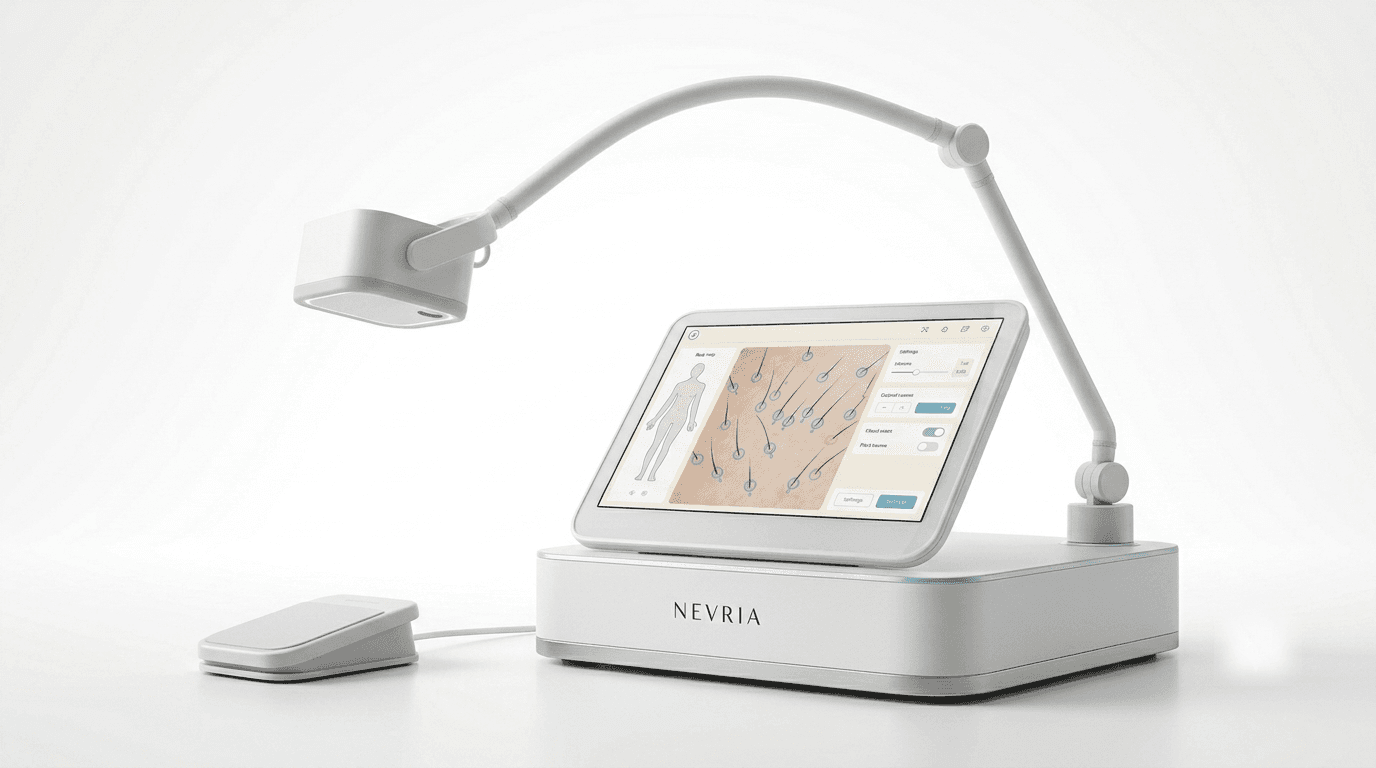
The complete Nevria Array system — an articulated arm and pod, a touchscreen showing a live follicle map, a footswitch, and an engraved NEVRIA base.

Nevria Array — the first model. Concept rendering; prototype in development.

Forever, in a fraction of the time.

Nevria is reinventing permanent hair removal — the first AI-automated, multi-probe electrolysis. Faster and more affordable for clients, more profitable for the businesses who provide it. This is the revolution in hair removal.

The problem

Electrolysis is the only thing that truly works. It's also slow, tedious, and expensive.

Electrolysis is the only FDA-recognized permanent hair removal method, and the only one that works on light, grey, red, and white hair. But it's done entirely by hand.

Placed by hand, one probe at a time

A practitioner inserts a single probe into one follicle and must judge its exact angle by feel. If the probe doesn't line up with the dermal papilla — the hair root — the current doesn't destroy it cleanly, so the follicle survives and the hair regrows. Precision is everything, and it's all manual.

Hair grows in cycles, so it takes many visits

Follicles cycle through growth, rest, and shedding phases; only actively growing hairs can be treated, so the same area must be returned to again and again.

The real cost adds up

A single upper lip typically means 15-minute treatments every 2–4 weeks for about a year, at ~$55 each — roughly $1,030 for one small area. Larger areas cost far more.

It works. It's just built around a human hand that can only move so fast.

The complete system

Meet Nevria Array — our first model.

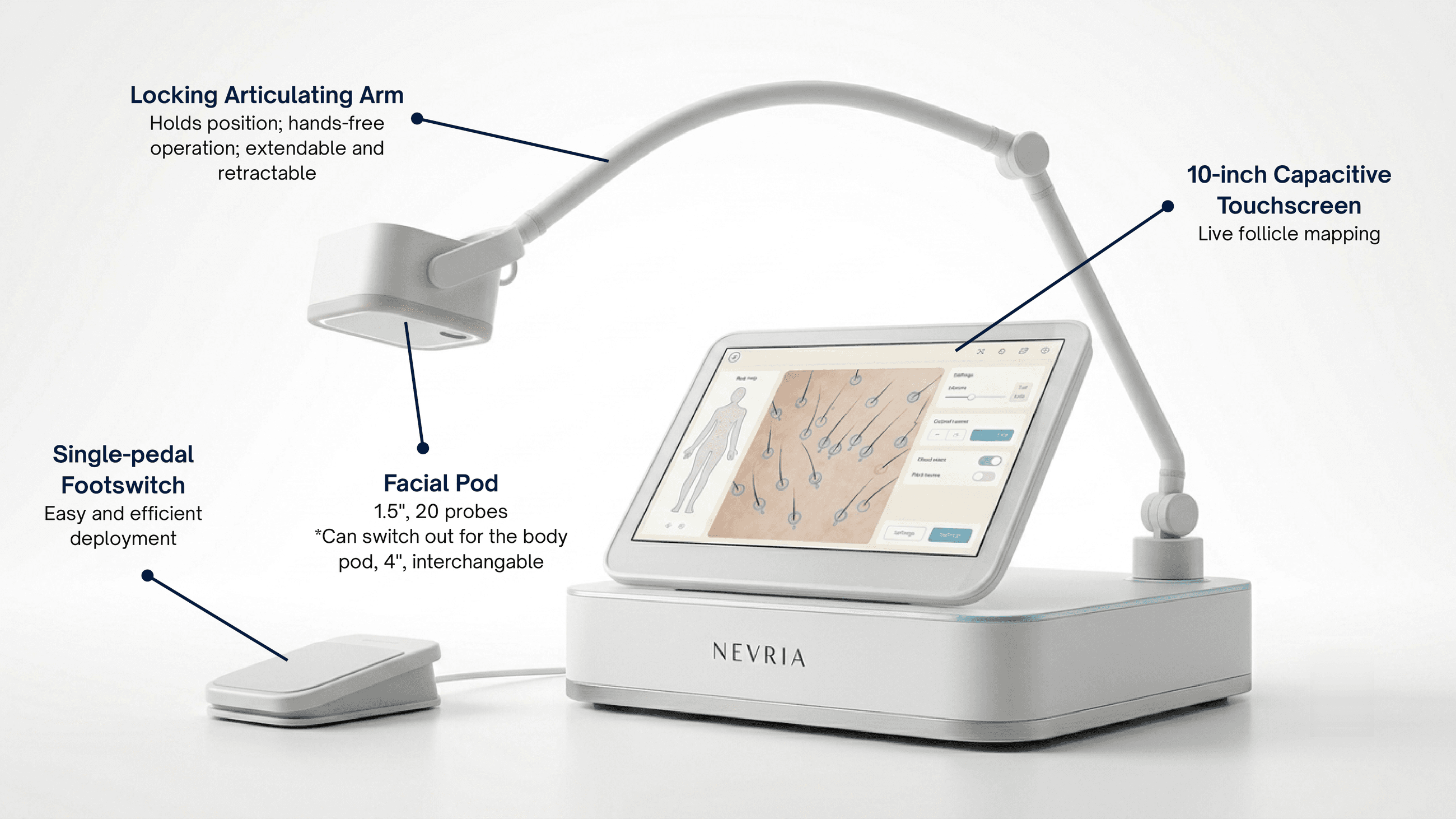
The complete Nevria Array system, labeled: locking articulating arm, 10-inch capacitive touchscreen, facial pod (1.5 inch, 20 probes) with interchangeable 4-inch body pod, and single-pedal footswitch.

Nevria Array — the complete system.

The first model pairs a facial pod (1.5″, 20 probes) with an interchangeable body pod (4″), a locking articulating arm, a 10-inch touchscreen, and a single-pedal footswitch. Future models will carry more probes and add blend modalities.

The science

How electrolysis removes hair for good.

The mechanism

  1. 1

    A fine probe slides into the follicle alongside the hair, down to the dermal papilla — the root that feeds hair growth.

  2. 2

    A precise current destroys those growth cells, so the follicle can't regrow.

  3. 3

    Because hair grows in cycles, only actively growing hairs can be permanently treated — which is why it takes repeat visits.

The hair-growth cycle

Hair grows in three cycles — anagen (active growth), catagen (transition), and telogen (rest and shedding). Only anagen hairs, still connected to the papilla, can be permanently treated — so repeat visits catch each follicle in its growth phase.

AnagenTreatable
Active growth

Attached to the papilla — treatable.

Catagen
Transition

Detaching — the window is closing.

Telogen
Rest & shedding

Disconnected — nothing to treat yet.

Only follicles in active growth (anagen) can be permanently treated.

Our first model

This is Nevria Array.

Our first model — 20 probes and flash thermolysis, in one pod that stays closed until the moment it works.

The Nevria Array pod open, its shutter retracted to reveal the array of probes inside.
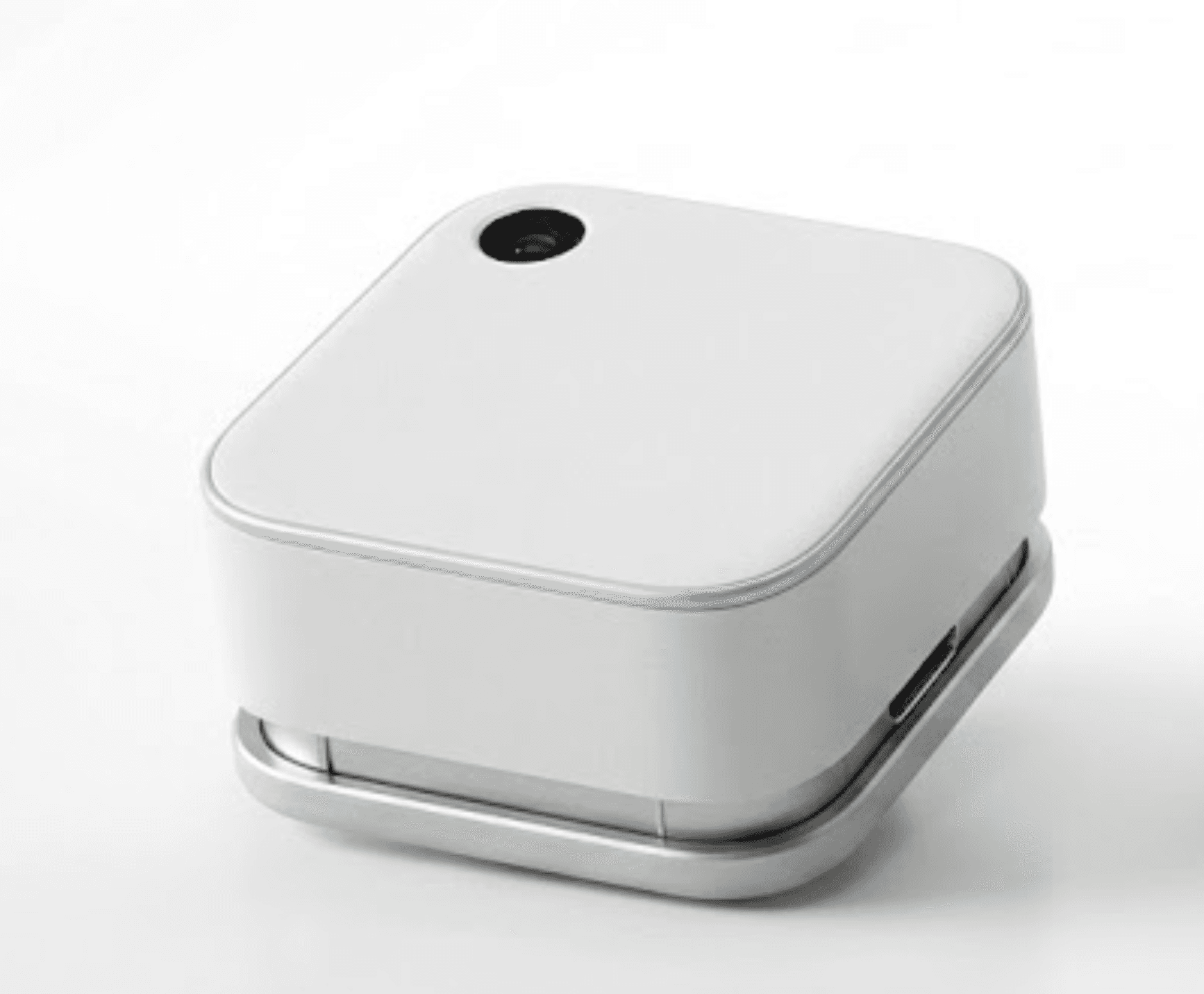
The closed Nevria Array pod — a clean white enclosure with a camera aperture and an ice-blue seam.

The pod stays closed until the moment it works. The shutter opens, the probes descend, and it's done — the client never watches a probe go in.

How Nevria Array works

A machine that sees every hair.

01

Map

The camera scans the skin; onboard AI finds every follicle and measures the angle each hair grows at.

Live follicle mapping on the Array touchscreen.

02

Engage — selective

Twenty probes, but each descends only if the camera detects a hair directly beneath that probe's position. A probe over bare skin stays retracted. Each engaged probe tilts to match its follicle's angle.

Only probes above a mapped hair engage; the rest stay retracted.

03

Treat & extract

Aligned probes fire a precise current into the dermal papilla at once; micro-extraction tweezers lift each treated hair cleanly out.

How a probe treats and extracts a single follicle.

04

Repeat, fast

Reposition and go again — a few seconds per pass instead of one hair at a time.

Aligned probes fire together — then reposition and go again.

How Nevria Array fills a generational gap.

Electrolysis has removed hair permanently since 1875 — but for 150 years it has been entirely human-driven, one probe at a time. Nevria Array is the world's first AI-powered, automated multi-probe electrolysis device. By letting a camera and AI find, align, and treat many follicles at once, it makes every treatment more accurate and dramatically faster — so technicians serve more clients and earn more, and clients spend less time and money.

Inside the pod

Nevria Array — engineered to see and treat.

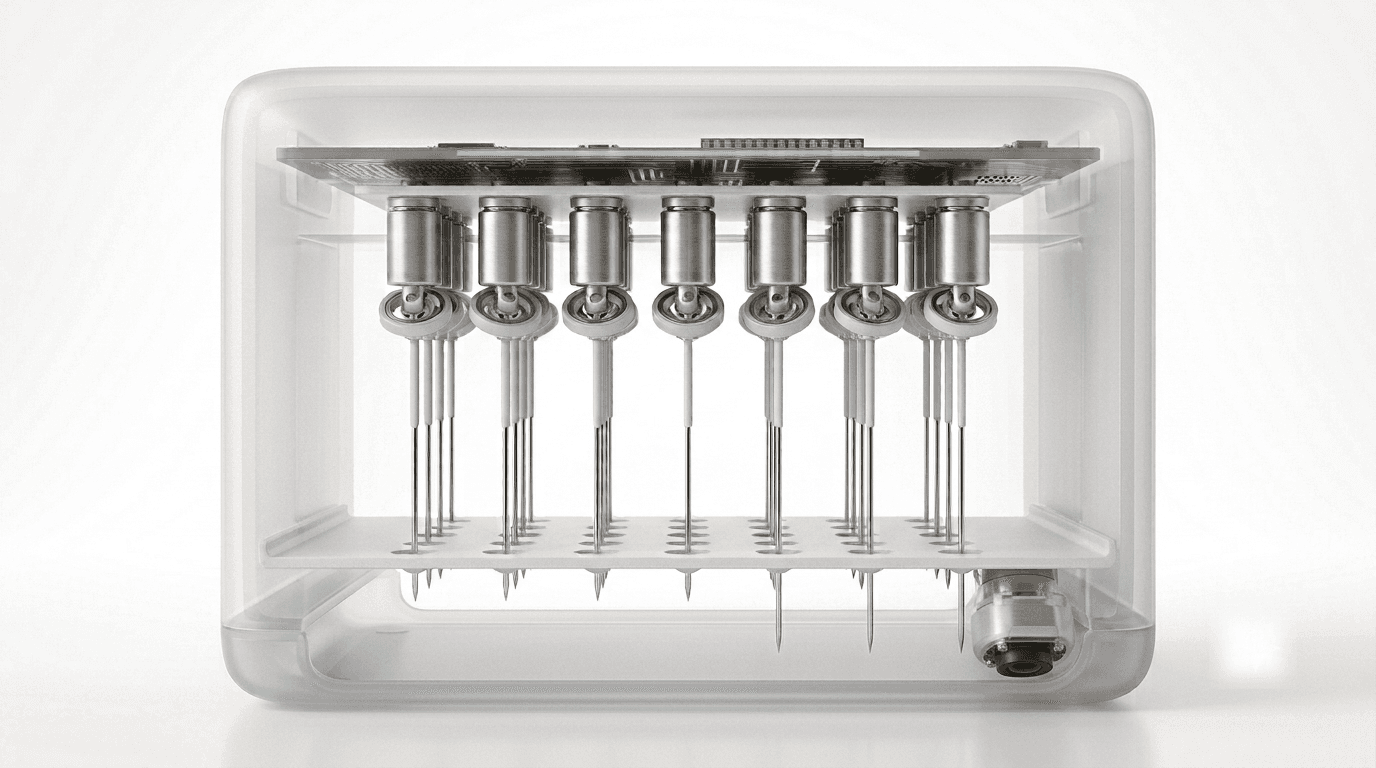
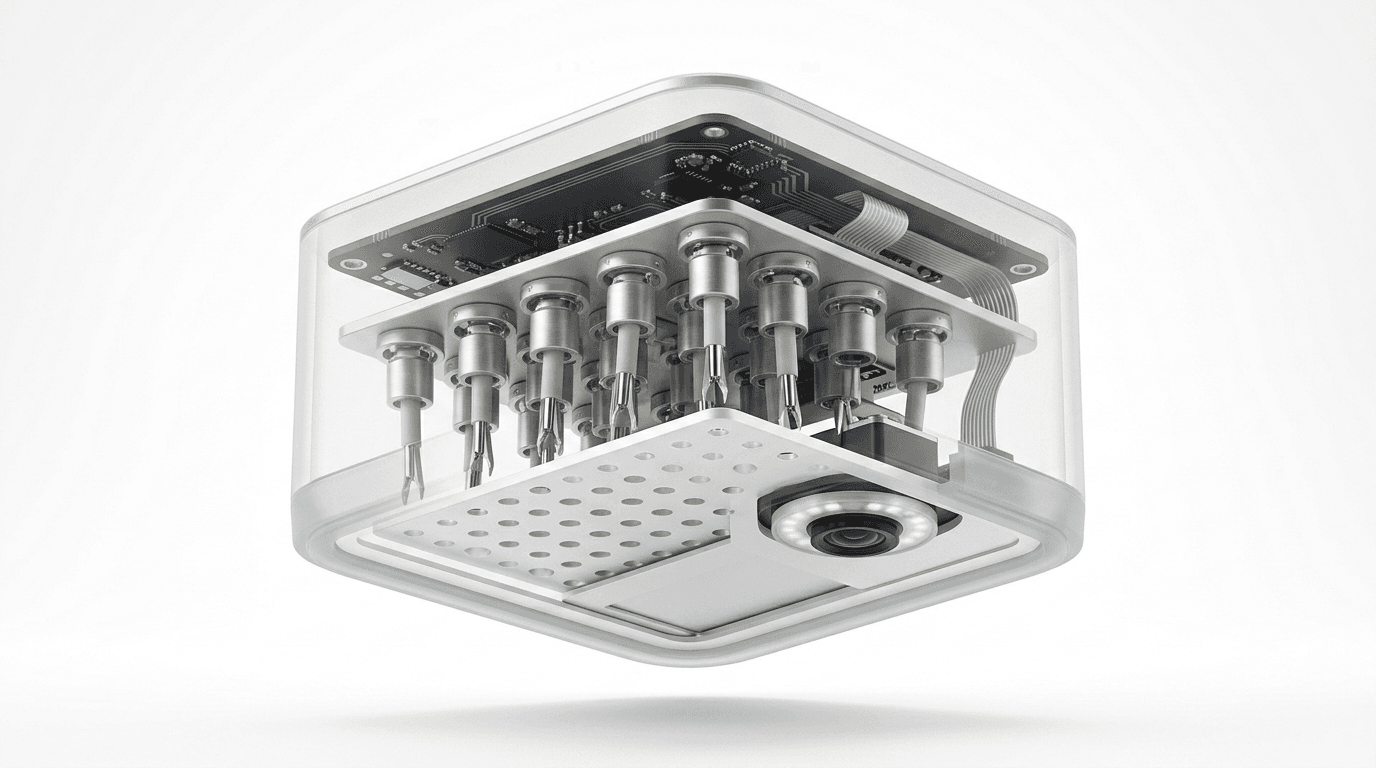
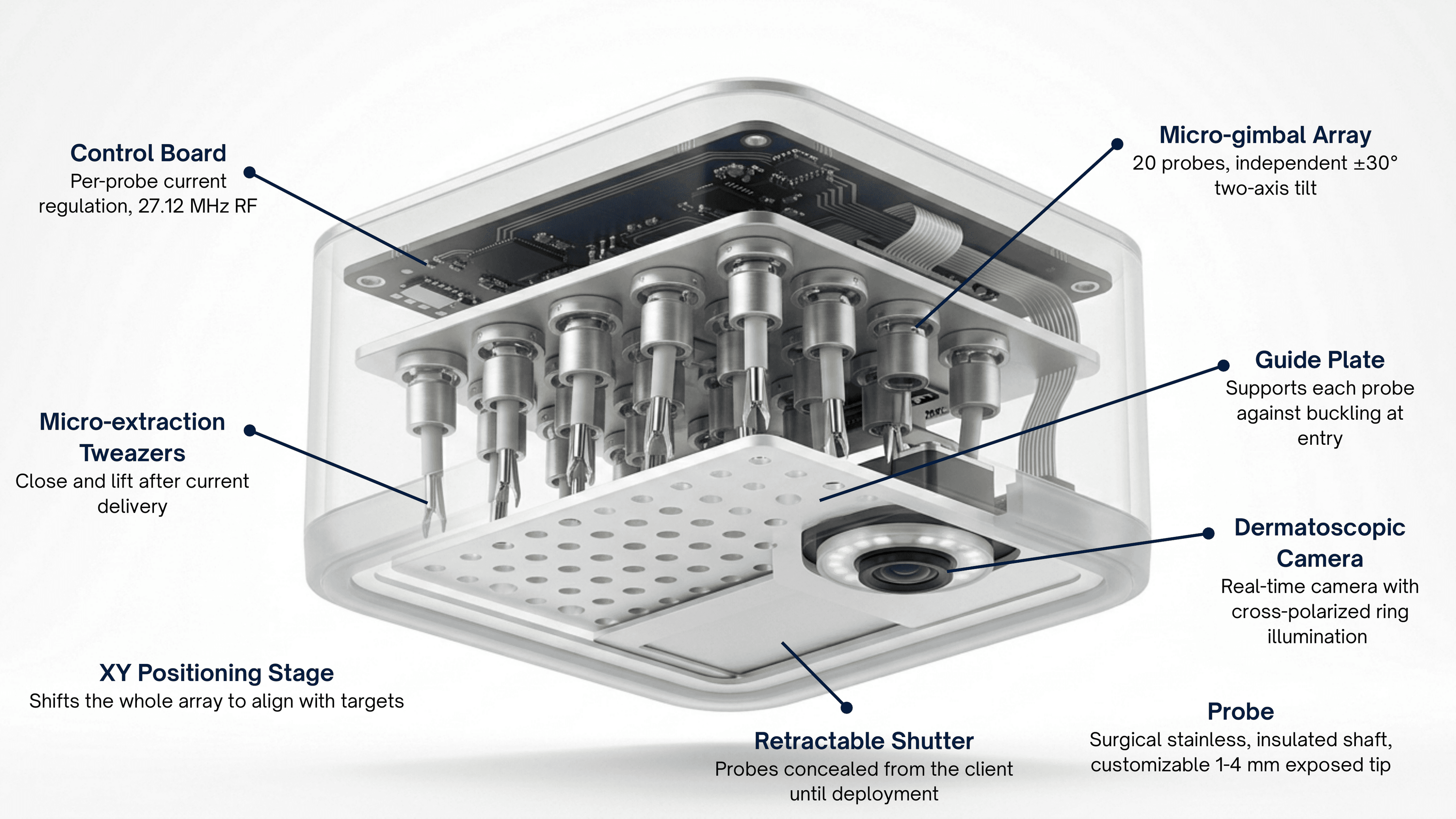
A control board, a bank of micro-motors, a precision guide plate, and a camera ringed with light — packed into a pod that sits an inch above the skin. Explore every component, or hit Enlarge for a full-screen look.

A three-quarter cutaway of the Nevria Array pod, showing its internal components.
The Nevria Array pod cutaway with every component labeled: control board (27.12 MHz RF), micro-gimbal array (20 probes, plus-or-minus 30 degrees), guide plate, dermatoscopic camera, probe (1 to 4 mm exposed tip), micro-extraction tweezers, retractable shutter, and XY positioning stage.
Scroll over the image for more details

Inside the Nevria Array pod. Hover to explore the components.

The approach

Nevria Array proves the model with 20 probes and flash thermolysis.

There are three ways to destroy a follicle. The Array launches with the fastest — because speed is the whole point of going parallel.

Galvanic

Direct current (DC)

Creates a chemical reaction (lye) that destroys the follicle. Very effective on distorted follicles, but slow — seconds to minutes per hair.

Thermolysis · Flash

Array uses this
High-frequency AC

Heats and destroys the follicle with alternating current. Flash delivers that heat in a fraction of a second — the fastest modality.

Blend

Galvanic + thermolysis

Combines both in one probe — thorough on curved follicles, but slower per hair.

Nevria Array launches with flash thermolysis (AC) because it's the fastest and pairs best with parallel, automated probes — proving the model at maximum speed. A future lineup will add blend modalities for coarse and curved follicles, selected per-follicle by the AI. Flash-first is a deliberate, disciplined strategy.

For electrolysis businesses

For electrolysis businesses — why us?

A traditional device clears roughly 40 hairs in a 15-minute session at ~$55. With Nevria Array's parallel probes, a business could clear 150+ hairs in that same 15 minutes — so each client finishes in far fewer visits.

That frees the chair to treat far more clients, at a price each can finally afford — while you bill about the same per hour. Drag the sliders to see it.

Simulation← drag the sliders
3.8× more hair cleared per hour of chair time
The same 15-minute appointment clears far more — so clients finish in a fraction of the visits, at a fraction of the cost.
16
$55
$50
150

When clients finish faster, does new demand fill the chair?

A waitlist keeps the chair full — the realistic goal.

Traditional
Nevria Array
Hair cleared / chair-hour
The fair, un-gameable comparison.
160
600
Visits to fully clear one area
Same result, far fewer trips.
38
10
What a client pays to finish
≈4.2× cheaper to complete — this is what drives demand.
$2,090
$500
Revenue / chair-hour
Per hour, revenue is similar — the win is that Nevria fills that hour with finished clients instead of one slow one.
$220
$200
Clients fully treated / month
At full demand, ≈3.9× more clients completed.
9
35

Per booked hour, both bill about the same. But Nevria finishes each client in ~1/4 the visits — so at full demand the clinic completes ≈3.9× more clients a month, and each pays far less to be done, which is what keeps the schedule full.

Illustrative estimate — not a forecast of any specific clinic's results. Assumes 4 sessions/hour, 22 working days/month, ~1,500 hairs to clear an average area.

We care about your success

Services included with purchase.

The Array isn't just a device — it comes with a team behind your business. Hover any card to see what's included.

Device maintenance

Kept running, every month.

Routine servicing, calibration, and rapid support so your Array is always ready. If something needs attention, we handle it — no surprise repair bills.

Included with every Array

Marketing strategies

A dedicated expert team helps you fill the chair.

Personalized marketing — from local campaigns to before/after storytelling — to attract more clients to the faster, more affordable treatment you now offer.

Included with every Array

AI updates & support

The device gets smarter over time.

Continuous AI model updates, technical support, and regular check-ups. Every pass helps the mapping improve, and you always run the latest software.

Included with every Array
The offer

The first 10 businesses pay $0 down — no upfront cost. You pay only from the additional revenue the device generates. Sign up now to claim a spot in the beta round.

A common question

Why not just laser?

Laser targets pigment, so it is not effective on light, grey, and red hair and often needs seasonal restrictions. Electrolysis — what Nevria automates — is the only method the FDA recognizes as permanent, on every hair and skin tone.

LaserNevria
Permanent
Works on light / grey / red hair
No seasonal sun restrictions
All skin tones

The difference

What separates Nevria Array from others.

Follicles treated at once
APILUS xCell Pro1
NevriaUp to 20 (first model)
Finds the follicle
APILUS xCell ProHuman, by eye
NevriaCamera + AI mapping
Aligns to the dermal papilla
APILUS xCell ProHuman, by feel
NevriaPer-follicle angle, measured
Confirms insertion before firing
APILUS xCell ProNo
NevriaImpedance check
Speed
APILUS xCell Pro1 hair at a time
Nevria~20× faster (target)
Works on light / grey / red hair
APILUS xCell ProYes
NevriaYes
Improves over time
APILUS xCell ProNo
NevriaEvery pass trains the model
Marketing + growth support for clinics
APILUS xCell ProNo
NevriaIncluded

~20× and probe counts are design targets for the first model, Nevria Array. Comparison reflects publicly described capabilities; not an independent test. The Apilus xCell Pro is a proven, respected machine — Nevria is the automation evolution of the same method.

Why I'm building this

I built Nevria because I've lived this problem.

Hanna — founder of Nevria. I'm building this because I've lived it.

hover over

See pictures from my own camera roll as a patient.

I'm Hanna — an electrical and biomedical engineering student. Unwanted hair has been one of my biggest insecurities for as long as I can remember, and I've spent over $6,000 trying to fix it. Laser barely helped; electrolysis worked — in five months I saw more than three years of laser ever gave me.

But as a college student, I felt how slow and expensive it is. I became a model at electrology schools, spent hours in the chair, and documented the industry-standard equipment firsthand. Every professional told me the same thing: it's painfully slow, and they'd love a tool that makes it faster. So I set out to build it — for the practitioners and the clients both.

I'd love to connect — han150.hu@gmail.com.
Our journey

From a personal problem to a real device.

We're honest about where we are: the earliest stage. No finished device yet, no revenue, no clinical data. Here's the real path so far — and where it's headed.

May 2026

The idea

After months of being an electrolysis patient — and as a student model at electrology schools — I realized an obvious gap in the field. Electrolysis was so time-consuming and inefficient. The idea for an automated, multi-probe device took shape: what if a camera and AI could do what a human hand does one hair at a time?

Concept: automated, multi-probe electrolysis

June 2026

Research & physics

A deep dive into the fundamentals: electrolysis physics and RF thermolysis, the three hair-growth cycles, the FDA 510(k) Class II pathway, and the current industry-standard equipment — documented firsthand in the field.

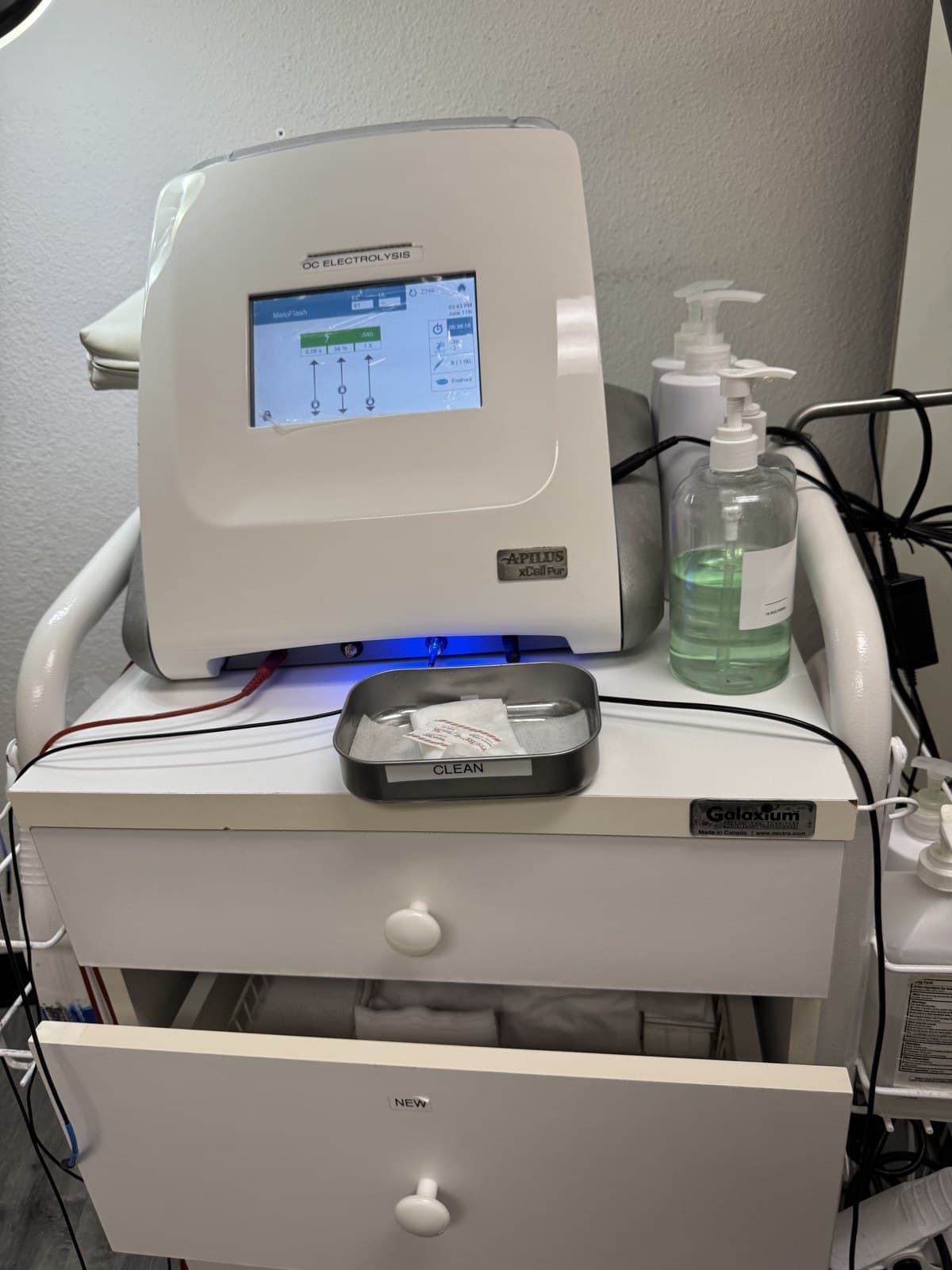
Primary research: the Apilus xCell Pur documented at a clinic.

July 2026

Device architecture & design

The full technical architecture for Nevria Array: a 20-probe micro-gimbal array, a dermatoscopic camera with AI follicle mapping, flash thermolysis, and a retractable shutter — designed end to end.

The Nevria Array pod architecture, labeled.

Late 2026

Provisional patent

File a provisional patent covering the selective-engagement mechanism — probes that descend only where the camera has mapped a real hair.

Provisional patent filing (projected)

2026 – 2027

First prototype & bench tests

Build the first 20-probe flash MVP and bench-test the numbers that matter: engagement rate, alignment accuracy to the dermal papilla, and clean extraction.

The Array pod internals — prototype target.

2027

Pilot businesses

Onboard the first $0-down beta businesses, run supervised treatments, and collect real throughput and comfort data to validate the model.

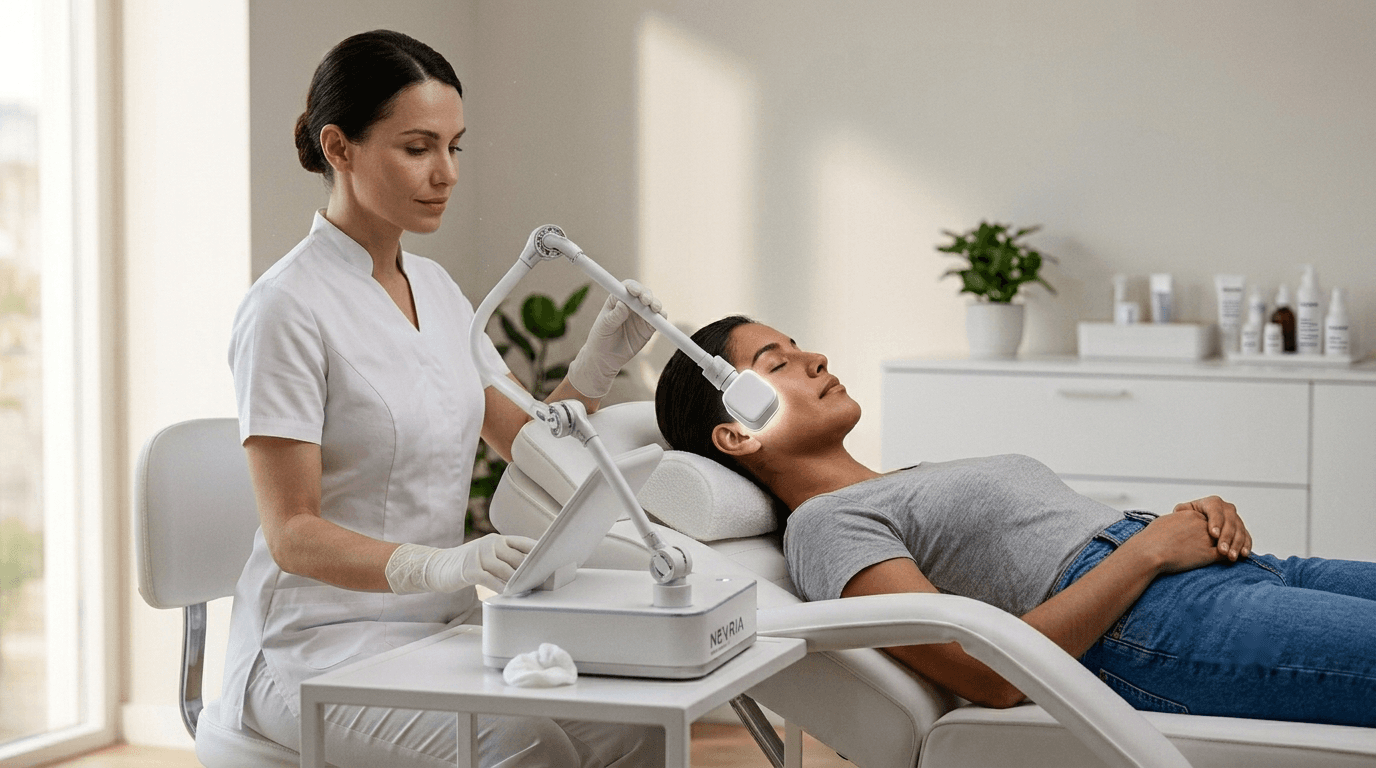
A pilot treatment in a clinic setting (concept).

2027 →

FDA 510(k)

Begin the FDA 510(k) clearance process, building on the same proven electrolysis mechanism plus Nevria's added insertion verification.

FDA 510(k) Class II pathway (projected)

2028 →

Early commercial

A cleared device in California clinics — and the start of blend-modality R&D for the next model, so the Array line grows beyond flash.

Early commercial + next-model R&D (projected)

Projected roadmap beyond July 2026, subject to change.

In conversation with

ElectrologistsClinic ownersBiomedical engineersRegulatory advisors

Advisors and pilot partners joining as we grow — placeholder.

Help us build

We're collecting real feedback — help shape Nevria.

Whether you run a clinic, perform electrolysis, or have just struggled with unwanted hair, your input directly guides what we build. It takes about 4 minutes, it's anonymous, and you can enter a drawing for a $25 gift card.

Anonymous · ~4 minutes · Open to clinics, technicians, and the public.

Clinic ownersTechniciansClients

Questions

The honest answers.

Didn't get your question answered?

Feel free to reach out — we'd love to hear from you.

Get involved

Be part of the beginning.

Join the waitlist

Be first to hear as Nevria Array moves from prototype to pilot. Businesses can reserve a $0-down beta spot.

Join clinical trials

Be first to try the technology — free electrolysis at a partner school. Schools can sign up to host, too.

Free electrolysis hair removal at a partner school. Your details are used only to follow up about the trial — never shared or sold.

Meet or work with me

Prefer to talk? Book a call — businesses, investors, engineers, and supporters all welcome. Or reach out directly; I read every message.